


For many defense attorneys, the independent contractor doctrine has a built-in problem: it seems too legal, too technical, and too reliant on multi-factor tests that aren’t friendly to the perspicacity of your typical juror. The fear is that jurors won’t get it or won’t care. Yet jury research and behavioral science point in another direction. When simply stated and tied to roles within real life, the independent contractor concept is often intuitive for jurors and potentially an effective motivator for defense verdicts.
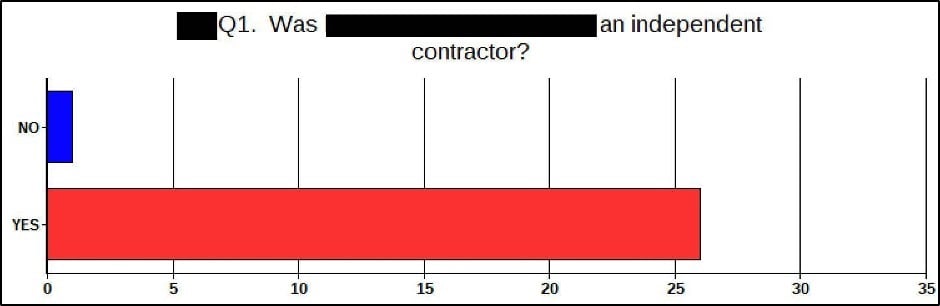
The reason for that stems, in part, from the way that jurors actually make decisions. Decades of research have shown that jurors do not evaluate cases by meticulously applying legal rules in a vacuum. Rather, they create stories that provide them with a framework to understand the evidence. This is commonly referred to as the “story model” of jury decision-making, developed by researchers Nancy Pennington and Reid Hastie. Their work demonstrates that jurors organize facts into a coherent story about what happened, who was responsible, and why (Pennington & Hastie, 1992). Within that framework, legal concepts like independent contractor status are not processed as abstract doctrines; they are absorbed into the broader narrative jurors are building.
That narrative tends to revolve around a few practical questions: who actually did the work, who had the expertise to do it correctly, and who could have prevented the harm. These are not legal questions, but they closely track the underlying principles of the independent contractor doctrine. When jurors conclude that a particular party performed the technical work and possessed the relevant expertise, they often assign responsibility to that party without needing to be persuaded through formal legal instruction.
Empirical research on tort decision-making reinforces this point. Studies examining how jurors assess causation and responsibility show that jurors tend to link liability to the actor they believe had control over the risk and the ability to prevent the harm (Hans & Vidmar, 1986; Robbennolt & Studebaker, 1999). This aligns naturally with the concept of an independent contractor. A licensed professional or specialized contractor is expected to make technical decisions, follow applicable standards, and recognize risks inherent in the work. When jurors understand that role, they often see responsibility as flowing to that party.
The real problem is not that the jurors are incapable of understanding the independent contractor doctrine. It is that they may initially misapprehend who occupies that role. First impressions count. The jurors may assume that the person they saw the most of, the person who talked to other people, or the person who sat at the counsel table as the corporate representative is “in charge.” Those assumptions are not the product of legal reasoning as much as they are the product of mental shortcuts people use to make sense of complex material quickly. Research on framing effects confirms that how roles are introduced and described can significantly shape how decision-makers assign responsibility (Tversky & Kahneman, 1981).
However, these initial impressions are not fixed. When the defense provides a clear and consistent explanation of each party’s role, who made decisions, who performed the work, and who had technical authority, jurors are often willing to revise their understanding. What might initially appear to be a complicated legal doctrine becomes a straightforward question of common sense. Jurors recognize that the party hired for their expertise is the one expected to get the work right.
This has important implications for trial strategy. Defense attorneys sometimes devote significant time to explaining the legal definition of an independent contractor, walking through factors such as control, supervision, and contractual relationships. While legally accurate, that approach can miss the mark with jurors. Research on jury comprehension suggests that jurors respond better to clear, concrete explanations than to abstract legal standards (Diamond, 2016). In practice, this means focusing less on doctrine and more on roles.
The distinction matters when jurors know that one party inspected the scene, made technical decisions, and did the work, while another party merely conveyed information or relied on that expertise. The legal term “independent contractor” then confirms a conclusion jurors have already drawn rather than being the basis for the conclusion.
Importantly, this dynamic also creates an opportunity for the defense. The independent contractor concept does more than clarify relationships between parties; it provides jurors with a logical framework for assigning responsibility in a way that feels fair. Jurors are often motivated to reach a just outcome, and they tend to align responsibility with capability. When the defense shows that a contractor had both the expertise and the authority to prevent the harm, it allows jurors to separate involvement from responsibility.
Ultimately, the independent contractor doctrine is not as foreign to jurors as it may seem from a legal perspective. It mirrors how people think about responsibility in everyday life. We expect specialists to know their field. We expect professionals to follow standards. And we expect those performing the work to ensure it is done safely.
The task for defense counsel is not to teach jurors a legal rule in the abstract. It is to help them clearly see who did the work, who had the expertise, and who had the ability to prevent the outcome. When that story is told effectively, the independent contractor concept does not feel complicated. It feels like common sense, and that is where it becomes most powerful.
References
Diamond, S. S. (2016). Jury decision making: Implications for and from psychology. Annual Review of Psychology, 67, 307–329.
Hans, V. P., & Vidmar, N. (1986). Judging the jury. New York, NY: Plenum Press.
Pennington, N., & Hastie, R. (1992). Explaining the evidence: Tests of the story model for juror decision making. Journal of Personality and Social Psychology, 62(2), 189–206.
Robbennolt, J. K., & Studebaker, C. A. (1999). Anchoring in the courtroom: The effects of caps on punitive damages. Law and Human Behavior, 23(3), 353–373.
Tversky, A., & Kahneman, D. (1981). The framing of decisions and the psychology of choice. Science, 211(4481), 453–458.
Recent Articles by Our First Court Team:
- The Virtual Verdict: Comparing Digital and In-Person Jury Dynamics
- Understanding Proximate Cause in Legal Defense
- Two Things Can Be True Simultaneously: Learning to See Through the Eyes of a Juror
- 4 Ways to Ensure Work Travel Doesn’t Wreck Your Routine
- Unveiling the Power Dynamics in Anchoring Damage
- Online Mock Trials vs. In-Person Mock Trials: Pros and Cons
- Top Ten Tips to Ace Voir Dire




Comments