

Although the word “trust” is even outlined on our currency, Americans’ trust has taken a dive, and this fact has rippling effects… even within the jury room. We have been aware of America’s tanking trust for some time now, but the numbers are more drastic than many realize. In a study by the Pew Research Center, they found that: “The share of adults who said 'most people can be trusted' declined from 46% in 1972 to 34% in 2018, according to the General Social Survey. In a 2023-24 Pew Research Center poll, an identical 34% said most people can be trusted.”1 Gallup reported updated statistics on media trust in September 2025, and the results follow a similar trend: “Americans’ confidence in the mass media has edged down to a new low, with just 28% expressing a ‘great deal’ or ‘fair amount’ of trust in newspapers, television and radio to report the news fully, accurately and fairly. This is down from 31% last year and 40% five years ago.” How does this plummeting trust affect the legal space?
In February 2025, Orrick, Herrington & Sutcliffe LLP. uncovered some answers when undertaking an extensive study. Orrick surveyed 1,282 individuals from across the United States with varied demographic backgrounds. These participants were asked a series of 150 questions, a number of which were asked in a similar study by Orrick in 2022. Orrick then compared these two groups and analyzed how participants’ answers had changed over the years. What they found may surprise you.
According to Orrick, “This glimpse into Americans’ attitudes reveals a dramatic loss of trust in core institutions – including the justice system – and a deep skepticism of corporate America, including technology, social media, oil and gas, pharmaceutical and financial services companies.” These individuals expressed fear that their grasp on many areas of their lives was slipping - they no longer felt in control. Jurors may feel that they are being handed back some control in the jury room, and may use that control to “apply their own view of what’s right and wrong rather than follow the law. They are also more likely to boycott companies they perceive to have taken positions with which they do not agree.”
It seems that trust in individuals and institutions has diminished across the board, although corporations have suffered a stronger blow. See, for instance, the following graphs below, which were answers to several of the survey questions in the 2025 survey by Orrick.
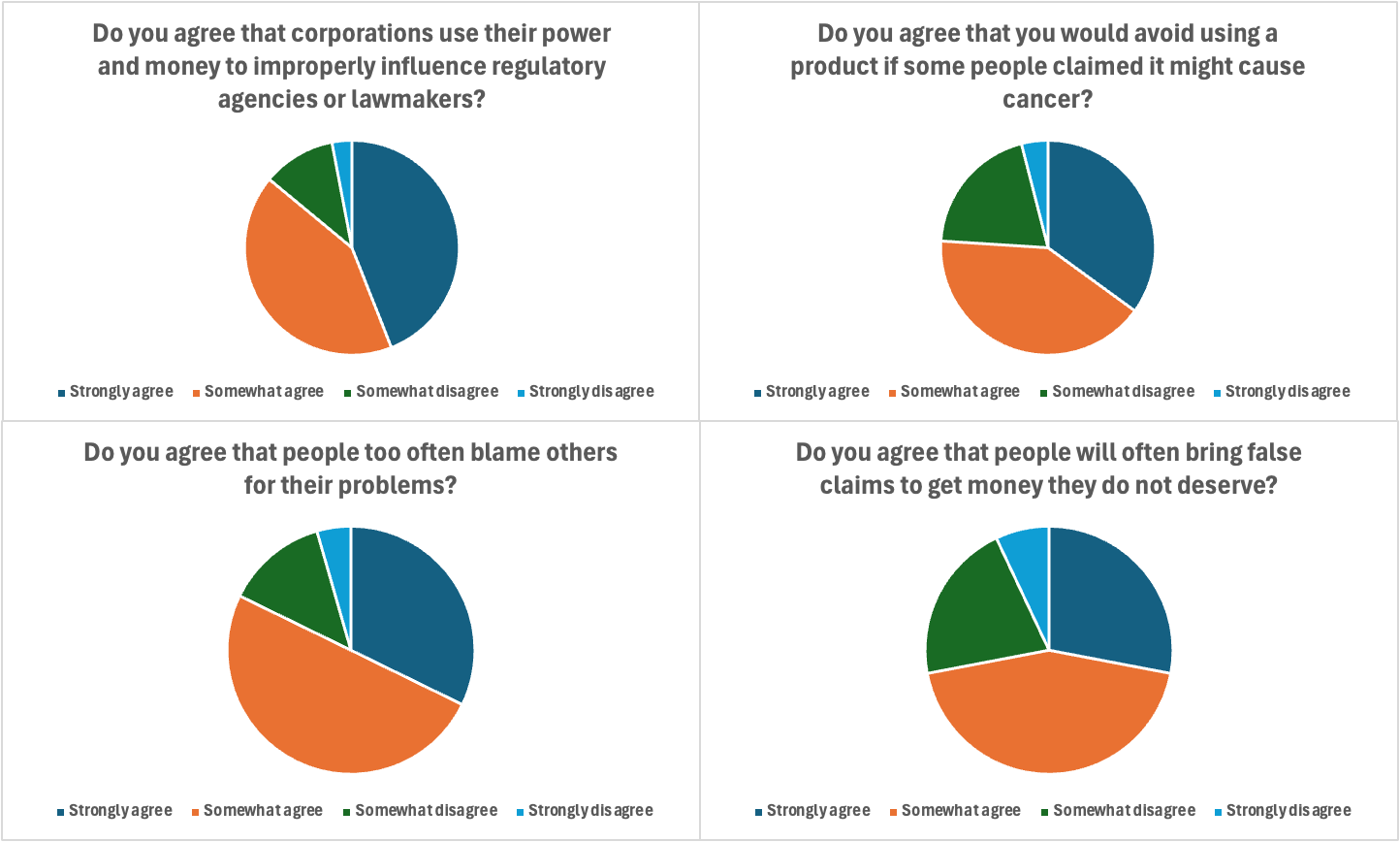
The top two questions display deep distrust in corporations and products, but the bottom two reveal that this distrust extends to individuals as well. Orrick revealed that today “65% of respondents are now willing to take matters into their own hands when the law does not support their idea of justice,” and “72% believe it is a juror’s job to send a message to corporations to improve their behavior.” These responses saw a double-digit increase compared to the results of the same survey questions in 2022.4 Orrick concluded that this dramatic loss of trust in organizations has influenced jurors to award larger damages and to agree to punitive damages. Additionally, this all-encompassing lack of trust could lead to each juror standing on an island of their opinions, and the verdict of the jury not being decided by the group, but by its most stubborn member.
According to Mother Teresa, founder of the Missionaries of Charity and the 1979 Nobel Peace Prize recipient, “I alone cannot change the world, but I can cast a stone across the waters to create many ripples.” Trial lawyers have the tough job of creating trust in the panel of skeptics deciding the case. Thankfully, there are many powerful tools to use when undertaking this task. Trial consultant Kristi Harrington, in her blog “Rebuilding Credibility in the Courtroom: Lessons for Trial Lawyers in an Age of Skepticism,” outlines several techniques for creating a bond of trust with the jurors. Start there. Occasionally, ripples become waves.
Resources:
- Silver, Laura. “Americans’ Trust in One Another.” Pew Research Center, Pew Research Center, 8 May 2025, www.pewresearch.org/2025/05/08/americans-trust-in-one-another/.
- Brenan, Megan. “Trust in Media at New Low of 28% in U.S.” Gallup.Com, Gallup, 30 Oct. 2025, news.gallup.com/poll/695762/trust-media-new-low.aspx.
- “2025 Jury Research: Into the Minds of Americans.” Orrick, www.orrick.com/en/Insights/2025-Jury-Research-Into-the-Minds-of-Americans. Accessed 25 Nov. 2025.
- “Groundbreaking Jury Research Reveals U.S. Jury Attitudes in a Polarized Society.” Orrick, www.orrick.com/en/Insights/Groundbreaking-Jury-Research-Reveals-US-Jury-Attitudes-in-a-Polarized-Society. Accessed 25 Nov. 2025.
Recent Articles by Our First Court Team:



Comments